
AI & Consciousness
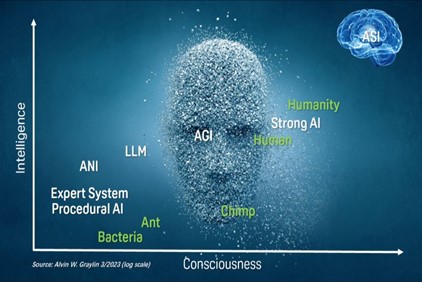
The rapid progress made by Large Language Models (LLMs) — e.g. ChatGPT — in recent times has rekindled the debate on when and if AI tools will achieve parity with human intelligence, commonly known as Artificial General Intelligence (AGI).
To understand the context, let us define human intelligence and Artificial Intelligence.
Definitions
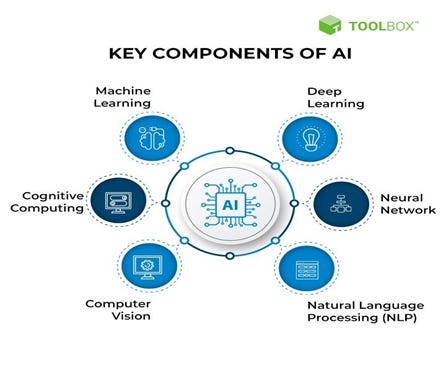
Artificial Intelligence is a set of tools developed by humans using software-based algorithms which make predictions. These tools have inbuilt methods of learning and use complex statistical methods. The diagram below breaks down the key components of AI.
Human intelligence, on the other hand, is complex and stems from consciousness or sentience, which is fundamental to any biological intelligence. It has self-perception and awareness through which it relates to the world around it.
The diagram below explains the levels of consciousness. More than six decades of Artificial Intelligence (AI) research and applications has not taken us any closer to Artificial General Intelligence (AGI).
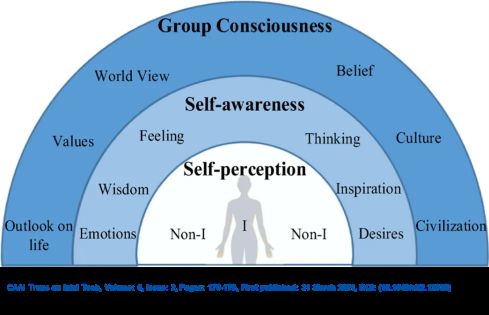
There is consensus that consciousness is the main reason for this lack of progress — often called the "hard problem of consciousness" (D.J. Chalmers).
I came across a chart on Twitter (without a way of verifying the data — more charts here) which set me thinking about how far we are from achieving AGI.
Can Machines Think?
Over centuries, the human mind has created machines using human intelligence. Industrialisation required humans to augment the operation of these machines on efficient assembly lines. With evolution, humans have created better machines capable of more complex tasks, providing people with more time to engage in higher-order thinking.
With advances in computing infrastructure, humans have been able to develop AI systems that can mimic some of the prediction, pattern-matching and learning methods of the human mind. These decisions still need to be augmented by humans, especially where there are life-threatening, financial or social implications.
Bottom Line
Remote work using digital tools and workflows has accelerated the need for businesses to streamline old processes and, in many cases, to adopt modern processes that lend themselves to the use of automation technologies.
Automation of workflows across front and back offices will explode in 2022. Key areas of growth in Robotic Process Automation (RPA) and Cognitive Automation using AI/ML across industries will multiply as businesses compete in the post-pandemic world.


